Breath by James Nestor
Leave a commentNovember 16, 2026 by styagi68
 We breathe approximately 20,000 to 25,000 times every day. We can survive without food for weeks, without water for days, but without breathing for only a few minutes. Yet, most of us spend very little time thinking about how we breathe. We assume that breathing is an automatic process, and therefore our body must be doing it correctly.
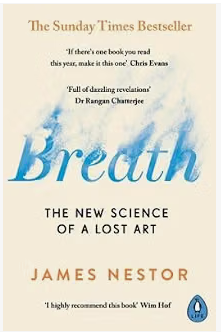
James Nestor challenges this assumption in his fascinating book Breath: The New Science of a Lost Art. He argues that human beings have gradually lost the ability to breathe efficiently, partly because of changes in our anatomy and partly because of our breathing habits. More interestingly, he connects modern respiratory science with ancient practices of pranayama, yogic breathing, and other techniques that can profoundly influence our physical and mental states.
Nestor is a science journalist, not a medical researcher. He travels around the world, meets scientists and practitioners, and experiments on himself to understand the science of breathing. His book brings together evolutionary biology, anthropology, physiology, neuroscience, and ancient spiritual traditions.
I found three ideas particularly interesting.
1. We Have Become Worse at Breathing Because We Have Stopped Chewing
One of the most surprising arguments in the book is that modern humans have developed anatomical structures that make breathing more difficult than it was for our ancestors.
Nestor describes how ancient human skulls generally had broader dental arches, more room for teeth, and better-aligned jaws. In contrast, modern humans frequently have crowded teeth, narrower palates, and smaller jaws. These changes can reduce the space available for the tongue and upper airway, making breathing through the nose more difficult and contributing to problems such as snoring and obstructive sleep apnea.
A major part of Nestor’s explanation is our changing diet. For most of human history, people ate relatively tough, fibrous foods that required substantial chewing. Roots, nuts, uncooked vegetables, and less processed foods placed significant mechanical demands on the jaw muscles and bones. Over time, particularly with industrial food processing, our diets became progressively softer. We started consuming refined flour, cooked and processed foods, and other products that required relatively little chewing.
The consequences may extend beyond our digestive system. Our bones and muscles develop partly in response to the mechanical demands placed on them. Just as lifting weights stimulates muscle and bone development, chewing stimulates the muscles and bones involved in jaw development. When children grow up eating predominantly soft foods, their jaws may not develop to the same dimensions as those of children who regularly chew tougher foods. Smaller jaws can lead to dental crowding and narrower airways.
Nestor refers to this phenomenon as a form of dysevolution: changes in our anatomy and lifestyle that may have made some aspects of modern human functioning less effective. There is an important distinction here. Evolutionary changes over thousands of years and developmental changes within a single generation are not the same thing. The relationship between chewing, jaw development, and airway dimensions has scientific support, but the claim that soft food is the principal explanation for modern breathing problems remains a hypothesis rather than a settled conclusion. Genetics, allergies, chronic nasal obstruction, and other developmental factors also matter.
Nevertheless, the central insight is intriguing: the way we eat may influence not only our nutrition but also the physical structure through which we breathe.
Nose versus Mouth Breathing
The second part of this argument concerns how we use our airways.
Our nose is not merely an alternative opening for air. It is a sophisticated respiratory organ that filters, warms, and humidifies incoming air. The nasal passages also contribute nitric oxide, a molecule involved in blood-vessel dilation and pulmonary physiology. Mouth breathing bypasses several of these functions.
Nestor describes an experiment in which he and another participant deliberately blocked their noses and breathed exclusively through their mouths for ten days. They experienced deterioration in several measures, including sleep quality, snoring, and blood pressure. When they resumed nasal breathing, these measures improved.
It is a compelling story, although an experiment involving two people cannot establish universal conclusions. The practical lesson is straightforward: for normal resting breathing, the nose is generally the preferred route. Persistent difficulty breathing through the nose, particularly during sleep, deserves attention rather than simply accepting mouth breathing as normal.
2. Carbon Dioxide Is Not Just a Waste Gas
This was perhaps the most counterintuitive insight in the book. We all learned in school that we breathe in oxygen and breathe out carbon dioxide. Oxygen is essential for life, while carbon dioxide is commonly described as a waste product of metabolism.
This description is correct but incomplete. Carbon dioxide plays an essential role in regulating breathing, maintaining blood acidity, and determining how effectively oxygen is delivered to our tissues. To understand this, we need to understand a phenomenon known as the Bohr effect.
When we inhale, oxygen enters the lungs and binds to hemoglobin in our red blood cells. These cells transport oxygen throughout the body. But transporting oxygen is only half the job. The oxygen must also be released from hemoglobin and made available to the tissues that need it. Carbon dioxide helps facilitate this process. In tissues where carbon dioxide concentrations are higher and acidity increases, hemoglobin’s affinity for oxygen decreases. This encourages oxygen to be released into those tissues.
Thus, the goal of breathing is not simply to maximize the amount of oxygen entering our lungs. It is to maintain the appropriate balance of gases so that oxygen can be delivered and used effectively. This leads to another surprising conclusion.
Breathing more does not necessarily mean getting more useful oxygen.
When we breathe excessively, a process known as hyperventilation, we remove carbon dioxide from the blood faster than the body produces it. Blood carbon dioxide levels fall, causing respiratory alkalosis and changes in blood-vessel constriction and oxygen release. This can produce dizziness, tingling sensations, lightheadedness, and sometimes anxiety.
Nestor introduces the work of Konstantin Buteyko, a Russian physician who developed breathing exercises based on reducing excessive ventilation and increasing tolerance for the normal sensations associated with rising carbon dioxide. The idea is to breathe more gently and efficiently rather than assuming that large, frequent breaths are always better. There is an important qualification. Carbon dioxide must remain within a healthy physiological range. Excessively high carbon dioxide can be dangerous, just as excessively low levels can be. The objective is not to accumulate carbon dioxide indefinitely but to avoid unnecessary overbreathing.
The Ideal Breathing Rhythm
Nestor discusses research suggesting that breathing at approximately 5.5 to 6 breaths per minute can have beneficial effects on cardiovascular regulation and the autonomic nervous system. This translates to approximately:
- Inhale gently for 5 to 5.5 seconds.
- Exhale gently for 5 to 5.5 seconds.
- Repeat for a few minutes.
This rhythm is sometimes called resonant breathing. It can enhance respiratory sinus arrhythmia, the natural variation in heart rate associated with breathing, and influence heart-rate variability and blood-pressure regulation. Interestingly, Nestor observes that several traditional prayer and meditation practices have rhythms that approximate this breathing frequency.
There is no need to believe in any supernatural mechanism to understand the potential benefits. Breathing is an automatic physiological process that we can also consciously regulate. By changing its rhythm, we can influence systems that are otherwise largely outside voluntary control.
3. Rapid Breathing Can Produce Altered States of Consciousness
The most fascinating connection to spirituality comes in Nestor’s discussion of deliberate rapid breathing. So far, we have discussed why slower, gentler breathing can be beneficial. But ancient spiritual traditions have also developed techniques that deliberately do the opposite: rapid, forceful, rhythmic breathing.
Examples include certain forms of pranayama, Tummo breathing in Tibetan traditions, the Wim Hof method, and Sudarshan Kriya, popularized by Sri Sri Ravi Shankar through the Art of Living Foundation.
Slow breathing is generally used to promote calmness and physiological regulation. Rapid breathing can temporarily produce a markedly different physiological and subjective state. When someone breathes rapidly and deeply, carbon dioxide levels can fall significantly. This changes blood pH, affects cerebral blood flow, and can produce unusual sensations.
People practicing intensive breathwork sometimes report tingling, vibrations, changes in body awareness, emotional release, visual phenomena, or feelings of profound connectedness. Some describe experiences resembling deep meditation or altered states of consciousness. These experiences can feel extraordinary, even mystical. But they do not necessarily require a supernatural explanation.
We know that consciousness is closely linked to the physiological state of the brain. Changes in oxygen and carbon dioxide, blood chemistry, neural activity, and autonomic arousal can influence our subjective experience. Breathing provides one way to deliberately alter some of these variables.
Sudarshan Kriya and Yogic Breathing
Sudarshan Kriya is particularly interesting because it combines different breathing rhythms rather than relying exclusively on rapid breathing. The practice includes slow, medium, and faster cyclical breathing patterns, traditionally performed in a structured sequence.
Practitioners frequently describe feelings of deep relaxation, emotional clarity, and enhanced well-being following a session. Research on Sudarshan Kriya and related yogic breathing practices has reported improvements in stress, anxiety, and depressive symptoms in some populations. However, the studies vary in quality, and larger, better-controlled trials are needed to establish the magnitude and durability of these benefits.
The physiological mechanisms are also not fully understood. It would be an oversimplification to attribute all the effects to carbon dioxide alone. Breathing rhythm, attention, emotional expectation, autonomic regulation, and the surrounding meditative environment may all contribute.
What interests me most is that ancient yogic traditions discovered through observation and experimentation that breathing can alter our mental state. They did not have instruments to measure blood gases, heart-rate variability, or brain activity. Yet, they developed systematic methods of regulating the breath to influence consciousness.
Modern science is beginning to explain some of these observations. The important distinction is between the experience and its interpretation.
A person may experience a profound sense of unity, bliss, or transcendence during intensive breathing. That experience is real as a subjective event. But it does not, by itself, establish that the person has connected with a universal consciousness or accessed a supernatural reality. This distinction is central to an analytical approach to spirituality.
Breathing can alter consciousness. Whether those altered states reveal something beyond the physical brain is a separate philosophical question. Intensive rapid breathing is also not without risk. It can cause fainting and other adverse effects, particularly in susceptible individuals. It should not be practiced in water, while driving, or in circumstances where losing consciousness could cause injury. People with significant cardiovascular, respiratory, or neurological conditions should seek medical guidance before attempting intensive techniques.
What I Take Away from the Book
Nestor makes a persuasive argument that breathing deserves a place alongside nutrition, exercise, and sleep as an important component of physical well-being. I would summarize the key lessons as follows:
- Breathe through your nose whenever practical. The nose performs important functions that the mouth does not, and chronic mouth breathing can be associated with respiratory and sleep problems.
- Pay attention to chewing and jaw development. Our modern soft-food diet may contribute to changes in facial development, particularly during childhood, although the extent of its contribution remains debated.
- Do not assume that more breathing is better. Carbon dioxide is an essential part of oxygen delivery and respiratory regulation. Excessive ventilation can disrupt this balance.
- Practice slow, comfortable breathing. A rhythm of approximately five to six breaths per minute may help regulate stress and improve short-term autonomic and cardiovascular measures.
- Recognize the power of breathing to alter mental states. Techniques such as pranayama, Sudarshan Kriya, and Tummo demonstrate how deliberate breathing patterns can produce unusual subjective experiences, some of which may have therapeutic value.
The book is not without weaknesses. Nestor occasionally moves from well-established physiology to speculative claims without clearly separating the two. Some of his experiments are compelling anecdotes rather than rigorous scientific evidence. The evidence supporting specific breathing techniques is also uneven.
Nevertheless, Breath succeeds in drawing attention to something fundamental that we have largely ignored. For me, its most interesting contribution is the connection between the physical body and the subjective experience of consciousness. In Hindu spiritual traditions, breath is often described as prana, a vital force associated with life and consciousness. The scientific interpretation does not require us to accept prana as a separate, invisible energy. We can understand many effects of breathing through physiology and neuroscience.
Yet, that understanding does not diminish the experience. It makes it more accessible. We do not need faith to recognize that controlling our breathing can influence our physical state, emotional experience, and awareness. We can observe these changes directly and examine their mechanisms scientifically.
This is where ancient spiritual practices and modern science can meet productively—not by assuming that ancient explanations were always correct, but by examining the phenomena they identified and understanding them through evidence.
My overall assessment: Breath is an engaging, thought-provoking book that makes a strong case for paying greater attention to how we breathe. Its scientific claims need to be evaluated individually, but its central message is valuable: one of the simplest tools for influencing our physical and mental well-being is something we have been doing since the moment we were born.
Sometimes, improving our lives does not require acquiring something new. It requires learning to do something familiar a little better.
The book is a great read for people who seek Analytical Faith.


